
Bituminous Polyurethane Waterproofing Coating
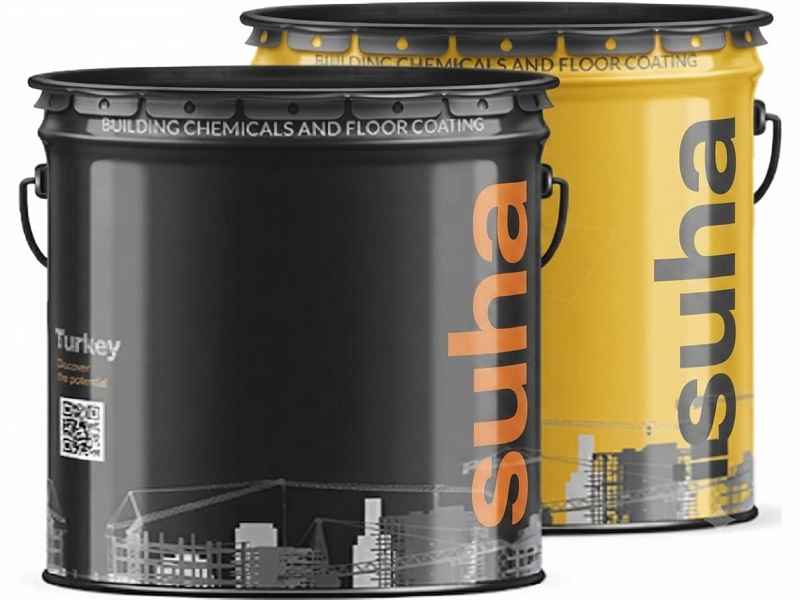
SUHA SHIELD PU BITUMEN-2K
Fast-Curing, Two-Component, Bitumen-Enhanced Polyurethane Liquid Waterproofing Membrane
DESCRIPTION
SUHA SHIELD PU BITUMEN-2K is a fast-curing, two-component, liquid-applied polyurethane-based material enriched with bitumen. It forms a highly elastic film by strongly adhering to almost any type of substrate. It offers exceptional resistance against chemicals and mechanical impacts, and can also double as a joint sealant. Its formulation is based entirely on elastomeric hydrophobic polyurethane resin, reinforced with chemically polymerized pure bitumen.
KEY FEATURES & ADVANTAGES
Fast curing capability.
Allows thick-layer applications without bubble formation.
Unmixed components remaining outside the application amount can be saved for future use.
Excellent crack-bridging properties due to its low modulus.
Effective resistance against chemicals.
Outstanding adhesion to all kinds of substrates, whether primed or unprimed.
Although thinning is generally unnecessary, it can be thinned with polyurethane thinner depending on site conditions.
Excellent thermal resistance; the product never softens.
Maximum service temperature is 80°C, and maximum shock temperature is 200°C.
Cold-resistant; the film retains its elasticity down to -40°C.
Outstanding mechanical properties, featuring high elongation, tensile, tear, and abrasion resistance.
Functions effectively as a water vapor barrier.
Can also be applied as a joint sealant.
The 1/1 volumetric ratio of the components makes the mixing process simple and straightforward.
RECOMMENDED APPLICATIONS
Gypsum and cement boards
Polyurethane insulation foams
Asphalt membranes
EPDM membranes
Bathrooms (under tile)
Verandas and balconies (under tile)
Cement-based roofs
Metal or fibrous roofs
Water tanks (excluding potable drinking water reservoirs)
Floors
Foundations
Bridge decks
Cut-and-cover tunnels
Irrigation channels
TECHNICAL SPECIFICATIONS & ENVIRONMENTAL CONDITIONS
Environmental Application Conditions
Relative air humidity must be a maximum of 80%, and application temperature (ambient and substrate) must be between +3°C and +35°C.
Open areas must remain free of rain for 24 hours prior to application, during application, and for 24 hours post-application.
Substrate temperature must be at least 3°C above the current dew point temperature. (Request the Ambient Temperature – Ambient Humidity – Dew Point Temperature chart from our company).
Compatible Substrate Types
Concrete, fibrous cement, mosaic, cement-based roof tiles, old yet well-adhered acrylic and asphalt coatings, wood, corroded metal, and galvanized steel surfaces. Please contact our technical department for other base layers.
Consumption Rate
Minimum consumption: 1.0 – 1.5 lt/m²
SURFACE PREPARATION & MIXING
Surface Preparation
The surface should preferably be cleaned using high-pressure water; completely free from oil, grease, fuel, and paraffin residues, as well as form-release agents, cement residues, wood chips, loose particles, and cured membranes.
Mixing
Mix equal amounts of the two components either manually or using a low-speed mixer (300 rpm) and apply immediately. The pot life of the mixture is 30–45 minutes at 20°C. For airless spray applications—especially when using a low-power machine—a small amount of thinner may be required.
Application Method
Apply the material using a brush, roller, or spatula.
PACKAGING & STORAGE
Packaging:
Component A: 20 kg | Component B: 20 kg
Component A: 200 kg | Component B: 200 kg
Storage Information: The material must be stored in a cool and dry place. When stored properly in its unopened original packaging, the shelf life for both components A and B is 1 year.
HEALTH & SAFETY PRECAUTIONS
Observe the Material Safety Data Sheet (MSDS) prepared in accordance with relevant EU directives.
Although it contains no volatile organic compounds, providing adequate ventilation in enclosed environments is strongly recommended.
Furthermore, methane gas seeping from the ground may accumulate inside tanks; this possibility must always be considered and safety precautions must be taken accordingly. Request the Material Safety Data Sheet (MSDS) from your supplier.
Engineered to perform under extreme hydrostatic pressure, our bituminous polyurethane hybrid coating combines the exceptional elasticity and UV resistance of polyurethane with the superior moisture-barrier properties of high-grade bitumen. This dual-action formulation forms a seamless, monolithic membrane that bridges structural cracks, accommodating thermal expansion and contraction without tearing or delaminating. Resistant to root penetration, stagnant water, and aggressive soil chemicals, it provides ultimate protection for subterranean foundations, retaining walls, podium decks, and roof terraces across demanding global construction environments.