
The Engineering Case for Vibration Isolation — Why Surface Specification Determines Structural Outcome
Vibration is not a comfort variable. It is a structural load — a cyclically transmitted mechanical force that propagates through a building’s substrate, its load-bearing elements, and ultimately its occupants and equipment, accumulating damage with every operational cycle that goes unmitigated.
The global anti-vibration pads market for heavy machinery was valued at USD 269 million in 2025 and is projected to reach USD 355 million by 2034 at a CAGR of 4.1% (IntelMarketResearch, 2026). intelmarketresearch.com Within that market, the specification decision that determines whether a vibration isolation system performs to engineering intent — or fails progressively under load — is the elastomer compound selection and dynamic stiffness calibration of the isolating layer itself.
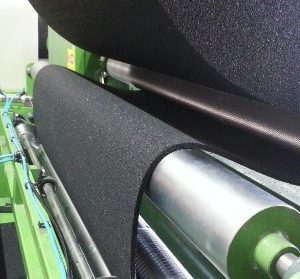
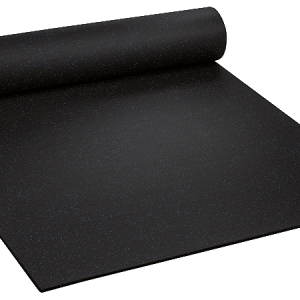
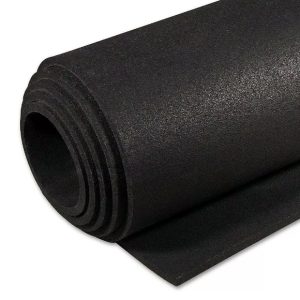
Suha Sport is a certified elastomer surface system manufacturer based in Istanbul, Turkey, engineering and exporting precision-compounded vibration isolation rubber matting to industrial facilities, commercial athletic venues, construction contractors, and mechanical installation engineers across 25+ countries. Our in-house vulcanisation and compound mixing capability means dynamic stiffness parameters, Shore A hardness, and compression set tolerances are controlled at the formulation stage — not approximated from off-specification commercial stock.Why Choose Our Acoustic Rubber Rolls?
Dynamic Stiffness — The Parameter That Determines Isolation Performance
Dynamic stiffness — expressed in MN/m³ — is the single most critical parameter in vibration isolation rubber specification. It defines the relationship between the applied oscillating load and the resulting deformation of the elastomer matrix under that load. Lower dynamic stiffness values produce lower system natural frequencies — which translates to higher isolation efficiency at the excitation frequencies generated by rotating machinery, impact loads, and structural footfall.
Suha Sport’s SBR-compound isolation matting is engineered across a dynamic stiffness range of 0.05–0.30 MN/m³ — calibrated per application profile:
- 0.05–0.10 MN/m³ — maximum isolation specification for precision machinery, rotating equipment, and acoustic studio sub-floor systems where sub-10Hz natural frequency is required
- 0.10–0.20 MN/m³ — commercial gym heavy-load zones: free-weight platforms, sled tracks, functional training areas — isolating impact peak forces of 3,000–8,000N generated by barbell drops and jump landing cycles
- 0.20–0.30 MN/m³ — light industrial anti-fatigue and workstation surfaces: sustained static load resistance with controlled deformation under continuous operator standing load
Compression Set — Long-Term Isolation Integrity Under Sustained Load
Compression set — the permanent deformation retained by an elastomer after a defined period of sustained compression — is the performance failure mode that most vibration isolation specifications overlook. An isolation mat with high initial dynamic stiffness performance but poor compression set resistance will progressively stiffen under sustained equipment load, losing isolation efficiency over time without any visible surface change.
Suha Sport’s compound formulations are specified to a compression set of ≤25% at 72 hours, 23°C, 25% deflection — ensuring long-term dynamic stiffness stability under the sustained base-plate loads of industrial machinery, gym equipment, and HVAC systems throughout a 15–20 year service life.
Natural Frequency — The Isolation Efficiency Threshold
Effective vibration isolation occurs when the system’s natural frequency is significantly lower than the excitation frequency of the source. The standard engineering target is a system natural frequency of one-third or less of the excitation frequency — at which point isolation efficiency exceeds 80%.
For rotating machinery operating at 1,450–3,000 RPM (24–50 Hz), Suha Sport’s low-stiffness SBR compound systems achieve natural frequencies of 8–15 Hz — providing isolation efficiency of 85–95% at standard industrial motor operating frequencies. nvlpubs.nist.gov
Athletic Training Zone Impact Decoupling System
Primary application: Commercial gym heavy-impact zones — Olympic weightlifting platforms, functional training floors, CrossFit sled tracks, plyometric areas
Engineering specification:
- Compound: Dual-layer — high-density SBR structural base + EPDM performance surface
- Base Layer Density: 1,100–1,400 kg/m³
- Shore A Hardness (base): 55–70 Shore A
- Force Reduction Coefficient: ≥35% under peak impact load (EN 14904 Class A)
- Peak Impact Force Absorption: Tested under 150kg barbell drop from 2.0m height — sub-base force transmission reduced by ≥60% vs. unprotected concrete
- Energy Dissipation: Hysteretic energy dissipation of 40–55% per impact cycle — measured as the ratio of energy absorbed to energy input during compression/rebound cycle
- Thickness Range: 15mm / 20mm / 25mm / 30mm / 40mm
- Slip Resistance: R10–R11 (DIN 51130) — maintained under chalk, sweat, and high-friction athletic footwear contact
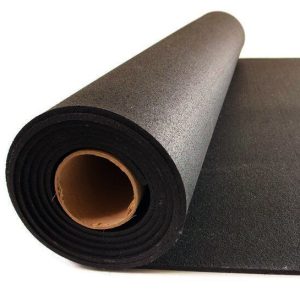
- Format: Rolls (1.0m, 1.22m, 1.5m width) and custom-cut platform inserts
Performance outcome: Joint stress reduction for athletes — force reduction coefficient ≥35% translates to a peak ground reaction force reduction of 800–2,400N per foot strike cycle in high-intensity training environments. Simultaneous sub-floor structural protection — preventing progressive concrete micro-cracking under repeated barbell drop events.
Floating Floor Structural Decoupling Underlays
Primary application: Multi-story commercial building sports halls, hotel fitness facilities, residential building gym installations — impact noise containment and vibration decoupling between occupied floors
Engineering specification:
- Compound: Precision-density SBR granule — particle size distribution controlled at mixing stage for uniform stiffness across roll area
- Impact Sound Reduction: ΔLw ≥17–22dB (EN ISO 717-2) — dependent on thickness and loading configuration
- Thickness Range: 5mm / 8mm / 10mm / 15mm
- Dynamic Stiffness: 0.08–0.25 MN/m³ (load-dependent — specify floor loading at inquiry)
- Airborne Sound Reduction Contribution: Rw +3–5dB as part of composite floor system
- Installation: Loose-lay floating installation — butt-jointed rolls with acoustic edge strip at all wall perimeters. No adhesive — maintains decoupling integrity
- Format: Rolls (1.0m / 1.5m width, 10m / 15m / 20m length)
Performance outcome: Floating floor natural frequency 8–12 Hz under standard commercial loading — providing >80% vibration transmission attenuation at typical footfall and gym equipment excitation frequencies. noisenewsinternational.net
Anti-Fatigue Ergonomic Surface Matting
Primary application: Industrial standing workstations, quality control inspection areas, assembly line operator positions, workshop tool preparation zones
Engineering specification:
- Compound: Medium-density SBR with controlled compression modulus — firm enough for postural stability, compliant enough for anti-fatigue performance
- Shore A Hardness: 45–60 Shore A — ergonomic anti-fatigue performance window
- Compression Deflection at 40 kPa: 8–15% — validated anti-fatigue working range per EN ISO 20347 ergonomic footwear performance reference
- Chemical Resistance: Tested against hydraulic oil, coolant, solvent, and industrial cleaning agents — surface integrity maintained across 10-year operational lifecycle in contaminated workshop environments
- Slip Resistance: R11 (DIN 51130) — maximum-traction surface for wet and contaminated industrial floor conditions
- Thickness Range: 10mm / 12mm / 15mm
- Format: Standard mats (600×900mm, 900×1500mm), rolls, custom cut-to-length
Seismic & Construction Vibration Isolation Underlays
Primary application: Buildings in seismic risk zones, construction sites adjacent to rail or metro infrastructure, industrial facilities near high-vibration external sources
Engineering specification:
- Compound: High-damping SBR elastomer — engineered for broad-spectrum vibration frequency attenuation, not a single tuned frequency
- Loss Factor (η): 0.10–0.25 — high internal damping coefficient for broadband vibration attenuation across 5–200 Hz frequency range
- Dynamic Stiffness: 0.05–0.10 MN/m³ — minimum stiffness specification for seismic application class
- Thickness Range: 20mm / 25mm / 30mm / 40mm
- Format: Large-format slabs, cut sheets, and custom panels to structural engineer’s specification
- Documentation: Full material test data sheets — dynamic stiffness, loss factor, compression set, density — provided for structural engineer specification and building control submission
Manufacturing Capability — Why Istanbul-Origin Compound Matters for Isolation Specification
Compound Control — The Factor Trading Companies Cannot Replicate
Vibration isolation performance is a compound-level property — determined by the molecular architecture of the elastomer matrix, the particle size distribution of the SBR granule, the binder-to-granule ratio, and the vulcanisation conditions under which the compound is cured. These parameters cannot be verified from a product certificate. They can only be guaranteed by a manufacturer with direct control over the compounding process.
Suha Sport’s Istanbul facility controls every stage of the compound production chain:
- ✅ Raw material intake verification — SBR granule particle size distribution and purity checked at goods-in
- ✅ Compound mixing control — binder ratio and granule density metered per product formulation — not approximated from standard commercial mixes
- ✅ Hydraulic press vulcanisation — temperature, pressure, and cure time parameters controlled per product specification — producing consistent Shore A hardness and dynamic stiffness batch-to-batch
- ✅ Batch-specific QC data — dynamic stiffness, Shore A, tensile strength, and compression set measured per production batch — not from a historical type-test certificate
- ✅ Traceability — every export shipment carries batch-traceable technical data sheets — enabling your structural engineer or machinery installation team to verify material properties against their specification
Istanbul Export Infrastructure — Logistics Advantages for Your Project
- Europe (Southern & Eastern): Istanbul → Mediterranean / Adriatic / Black Sea port transit 3–8 days — significantly shorter programme risk window than Far East alternatives
- MENA: Istanbul → Gulf ports 8–12 days — competitive with Asian-origin supply with full EN standard documentation alignment
- Global FCL capability: Multi-container project supply coordinated from Istanbul port — confirmed production and shipping schedule at order stage
- 1 business day quotation turnaround — dynamic stiffness specification, thickness, density, and format confirmed per your application load data
- In-house export documentation — commercial invoice, packing list, certificate of origin, technical data sheets, material safety data sheets — all prepared by our export team without third-party intermediaries
Technical Certifications & Documentation Stack
Every Suha Sport vibration isolation and structural decoupling product is supplied with a project-ready documentation package:
- 📋 EN ISO 717-2 — Impact sound reduction (ΔLw) per floating floor underlay specification — measured and documented per product and thickness
- 📋 EN 14041 — CE compliance for resilient surface systems — essential characteristics documentation for European commercial building and industrial facility specification
- 📋 REACH Compliance — EU chemical safety — restricted substance absence confirmed per compound formulation — mandatory for European market specification on publicly-funded and industrial projects
- 📋 Dynamic Stiffness Test Report — MN/m³ values per product and loading configuration — for structural engineer and M&E contractor specification packages
- 📋 Shore A Hardness Certificate — ASTM D2240 — per production batch
- 📋 Tensile Strength & Compression Set Data — per compound formulation
- 📋 Loss Factor Documentation — internal damping coefficient per frequency range for seismic and broadband isolation applications
- 📋 Material Safety Data Sheets (MSDS) — per product per batch — for building control, contractor H&S files, and facility operator compliance
- 📋 Certificate of Origin — Turkish manufacturing origin — per shipment for customs classification
Industry Applications — Specified by Sector
Commercial Gym & High-Performance Athletic Facilities
- Heavy-impact zone decoupling under Olympic platforms and CrossFit equipment
- Multi-story gym installations requiring ΔLw ≥17dB floor-to-floor impact transmission attenuation
- Anti-fatigue ergonomic surfaces for functional training and recovery zones
- Peak impact force reduction ≥35% protecting both athlete joint integrity and structural sub-floor from cumulative load damage
Industrial Facilities & Manufacturing Plants
- Rotating machinery base isolation: electric motors, compressors, pumps, CNC equipment
- Isolation efficiency ≥85% at standard industrial motor excitation frequencies (25–50 Hz)
- Anti-fatigue workstation matting: Shore A 45–60 for ergonomic standing operator support
- Chemical-resistant surface compound for contaminated industrial floor environments
Commercial & Multi-Story Construction Projects
- Floating floor decoupling systems for sports halls, hotel fitness centres, and residential building gym installations
- ΔLw ≥17–22dB impact noise containment between occupied building floors
- Structural protection from construction vibration in adjacent infrastructure projects
- Seismic isolation underlays for buildings in earthquake risk zones — documented per structural engineer specification
HVAC & Building Services Mechanical Plant Rooms
- Generator set, chiller, pump, and AHU base isolation
- Broad-spectrum vibration attenuation: loss factor η 0.10–0.25 across 5–200 Hz
- Prevents structure-borne noise propagation from plant rooms to occupied building areas
- Custom pad dimensions and stiffness calibration available per equipment mass and footprint specification
Frequently Asked Questions — Structural Engineers & Procurement Managers
What dynamic stiffness values are available for heavy machinery isolation?
Suha Sport’s SBR isolation matting is available from 0.05 MN/m³ (maximum isolation — rotating equipment) through 0.30 MN/m³ (anti-fatigue workstation surfaces). Specific dynamic stiffness targets are engineered per your equipment mass, operating RPM, and sub-floor load-bearing specification. Submit your application data for a calibrated product recommendation.
Can you provide batch-specific dynamic stiffness test reports for structural engineer submissions?
Yes. Dynamic stiffness, Shore A hardness, compression set, tensile strength, and loss factor data are documented per production batch — not from a generic type-test certificate. Full technical data sheets are provided with every export shipment and are available in advance for pre-specification review.
What is the compression set performance of your isolation matting under sustained machinery load?
Our SBR compound systems are specified to ≤25% compression set at 72 hours, 23°C, 25% deflection — ensuring long-term dynamic stiffness stability under sustained equipment base-plate loading across a 15–20 year service lifecycle.
Do you manufacture custom isolation pad dimensions to equipment base-plate specification?
Yes. Custom pad dimensions, stiffness calibration, and compound density are available as standard production options. Submit your equipment footprint, mass, and RPM data for a custom isolation specification within 48 hours.
What impact sound reduction can I specify for a floating floor gym installation in a multi-story building?
Our floating floor underlay range delivers ΔLw 17–22dB impact sound reduction per EN ISO 717-2 — dependent on thickness (5mm–15mm) and floor loading configuration. Full acoustic performance data is provided for architect and acoustic consultant specification packages.
Request Your Technical Specification Package or Bulk Quote
You are specifying vibration isolation rubber matting for a heavy machinery installation, a commercial gym fit-out, a multi-story construction project, or an industrial anti-fatigue programme. Suha Sport engineers it at our Istanbul facility — to your dynamic stiffness target, your compound specification, and your project’s dimensional requirements — and ships it factory-direct to your destination port.